Sunday, 31 January 2016

Jelly Ear and a Sticky End

It was very wet and windy when I went to the wood this morning but it takes more than rain and mud to keep these youngsters away. In fact soon after this photo was taken they were heading for the water. Lots to see and lots to do. It all seemed very exciting. Forest Schools seem to be gaining in popularity, mixing fun and education with teaching respect for wildlife and the environment. And there's no substitute for just getting out and doing it. This is the Badgers Forest School which  featured in an earlier post. If you are interested click here.

  There is no shortage of crows in Badock's Wood and they are often seen feeding in and around the river. Here these are picking food from the river bed and amongst other creatures  these could be water shrimp or mayfly larvae. The latter can spend about a year developing in the water. They will hatch into adult mayflies which fly into the air, then live for only one day in order to mate and produce the next generation of larvae. They don't even have a need to eat. There are several species of mayfly but a piece of video from Russia demonstrates the short life of the adult fly. click here.
If you'd like to know more about this interesting creature and how it fits into the food chain it's worth reading this article. The article is American but is relevant and concise, Mayflies.  Members of FOBW (Friends of Badock's Wood) will be monitoring the numbers of fly larvae in the river during 2016 as an indication of the presence or absence of pollution.
The ash tree that fell over the river before Christmas is now an accepted feature and seems to fit into the landscape very well. See left.
One of the bonuses of wet weather is the greenery. It's one of the first things you miss when you go to drier countries and although we sometimes moan about our weather for being so wet and unreliable, there certainly are disadvantages to having long, dry, hot spells. The mild winter has allowed plants to continue growing and particularly some of the mosses at the moment are a very vibrant green.
The other day I was pleased to see a moorhen in the Trym where it enters the wood; it was well protected by the brambles and shrubbery. It's not impossible that it could nest there but I think it's more likely that it came upstream from the wildlife park.
 This is the short lane between Doncaster Road and Badock's Wood. There is plenty of litter. In fact there were two full bin bags that have been left for a long time under the brambles.
On Saturday morning (23rd January), eight of us spent a couple of hours picking up the litter and Geoff persuaded us to separate the aluminium cans for recycling. We squashed each one and he was able to recycle a fairly full binbag of cans. He also quizzed us on how many hours of television we could watch with the energy saved from each can (?) and how many standard aluminium cans make a ton. If you are interested to know the answers to these questions and learn other fascinating facts you might like to look at this website - click here. 
The February litter pick will be on Saturday 27th and will involve some time picking litter from Trymside and then moving into Badock's Wood to spend time clearing an area here. More details later. On Saturday we picked up all the litter shown in the photos, and also walked along the stream to clear part of that as well.
Where on earth does it all come from ??


 You can see some of the bags here but you can't see the large advertising hoarding and the wall mirror that we also found. Thank you Jerry from the Parks Dept for arranging collection of the bags so promptly.
I think you can tell from the smiles that we were very pleased with our morning's work and several walkers thanked us during the morning.
If you'd like to join us next time, email to fobwlitter@yahoo.co.uk, look at the FOBW. website or watch for posters around the wood.

The photo on the right was taken on Sun 24th.
 You'd be forgiven for thinking the bird is a sparrow. In fact in the past it was called a hedge sparrow but it's not related at all to the sparrows, it's a Dunnock and the similarity to a sparrow is superficial. This bird has a finer beak, more suitable for eating insects and small seeds whereas the beak of a sparrow is thicker, more for breaking seed and eating scraps. If you listen to a flock of sparrows you can tell that they're only chatting and gossiping. The Dunnock has a very sweet song - listen here.


There are plenty of Horse Chestnut buds about in the wood. I can't resist touching them but it can be a bit messy because they are very sticky. Give it a try. This apparently helps keep its scales wrapped firmly around the sensitive growing tip protecting it from frost and perhaps insects. The bud will develop remarkably quickly when winter gives way to warmer weather. You can read more about horse chestnut trees here.


You can see this jelly ear beside the path that leads from Lake Road up to the Ceramics at the North Entrance. Someone said that it was rather unattractive but I think it looks different with the light behind it like this. It's a hardy fungus and can be seen all year round even with normal winter temperatures. Apparently it's edible but not necessarily enjoyable. Perhaps the name itself is a little off-putting.

Now, slugs can be fairly described as unattractive but they are very functional; important in the breakdown of vegetable matter. I don't know what species of slug these are but when/if I have more time I would like to look further into it.  There are about 20,000 slugs in the average UK garden and they are an important food source for some birds and hedgehogs. Thrushes can seem quite vicious as they swipe a slug from side to side on the ground to scrape off the unpleasant slime. Here is an interesting site, with plenty more information. - slugs. 

 Several walkers have mentioned that they sometimes hear the Great Spotted Woodpecker drumming in the woods but have never seen it. Well, I suppose part of the answer is that you need to stand still for a while and look high in the trees where it feeds and drums. I saw one today in Stoke Park with its bright red feathers on its rear. There may be only a few in the wood but their nest sites are clearly seen. I should say that although the Green Woodpecker can sometimes be heard and seen seen high in the trees, it more often feeds on the ground, often feeding on ants in fields and gardens. It doesn't drum either.
In contrast there are many squirrels in the wood. I see and hear them all the time as I walk around. They make all sorts of strange sounds, sometimes making sounds that could be confused with a bird such as a magpie. But I cannot find their sleeping quarters, a dray (or drey). There must be plenty of them around in the trees and perhaps they will be more obvious when there are young to nurse but at present I cannot find one.
These two woodpecker holes are in trees beside the Trym. They are easiest to see when walking away from the Triangle; on the right of the river. Hopefully they will be in use soon. Look high in the trees and I'm sure you will find them.

Notes:
  • To see The Friends of Badock's Wood website click here.  
  • You are welcome to join the FOBW Work Party to cut back invasive Wilsons Honeysuckle on Saturday February 6th at 10am. For information see posters around the wood or send an email to fobwwork@yahoo.co.uk . Instruction and equipment will be provided. 
  •  You can click on the photos to enlarge them.
  • If you would like to receive notification of future post please put your email address in the box at the top right of this page.
  • You can comment on anything in this blog by emailing me at badockswood@virginmedia.com 

mike townsend


Thursday, 21 January 2016

A Regular Health Check for Our Trees


 We have had a few very frosty mornings recently. But often with frost comes a clear, sunny day. This was Wednesday (20th Jan). Crisp, icy grass crunching underfoot and sunshine at first in the tops of the trees but then gradually working its way down to sparkle on the grass.

Although the air was cold there was some warmth in the sun and the birds were warming themselves in the sunny areas after a long cold night. It is important for them to find food early before they lose too much of their weight and strength.
It's a dangerous time for the smaller birds. During the week I saw a Sparrowhawk swoop down to pluck a grey wagtail from the Trym. Fortunately for the wagtail it escaped and flew away up the river calling out  a loud warning. It was early morning and the hawk would have been very hungry.

 The hawk flew straight towards a pigeon in the trees above but it escaped between the branches.
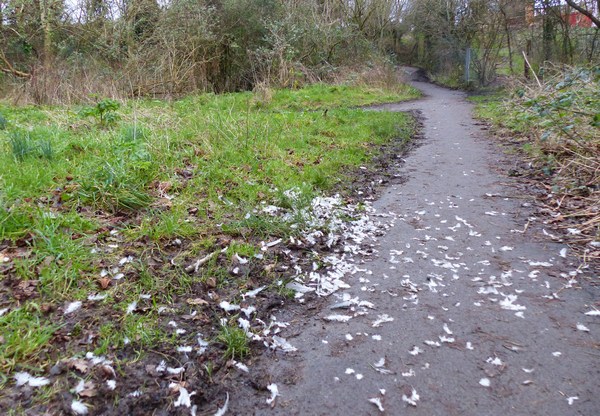
I have since found evidence where other pigeons haven't been so fortunate. It isn't safe for birds to stand around for long in open space feeding. There could be a predator watching from a nearby branch. The Sparrowhawk will more often take smaller birds but a large female will take a pigeon or a dove.
The prey has clearly had feathers removed at the site or lost them in the struggle but they have not been eaten here.
 The pigeon will have been carried off to a tree stump or convenient place where the predator would eat it or if it was feeding chicks it would prepare the carcass for the chicks. I couldn't see any remains close by but I will be looking out for them. If you are interested in looking for signs left by wild animals whether signs of feeding, droppings or tracks you might be interested in a book I bought myself for Christmas.  It's called The Nature Tracker's Handbook by Nick Baker. It has an RSPB label. See it here. It's full of information and I shall have some fun looking for owl pellets and the like.


 There were several birds searching for food on that cold morning. This is a redwing. It had been in the trees between the Greenway Centre and the Meadow but there aren't many berries which is its usual food source and so it went down to the ground to see what it could find. They can be in large flocks and quickly remove all the berries from a tree but this one seemed part of a small group.


This blackbird was looking for food amongst the frosted grass and undergrowth but I think the jay was taking a break and enjoying the sun's warmth. The jay primarily eats acorns but also nuts and other seeds in winter. In spring and summer it will eat the eggs and chicks of other birds. However, it is a very striking bird with the flash of blue on its wings and its black moustache.


 The coppicing work party on Jan 9th was a great success. The Avon Wildlife Trust and Friends of Badock's Wood joined forces to coppice some of the hazel near the Triangle. This involves cutting the hazel back to almost ground level so that more light gets to the ground encouraging smaller plants. The hazel will grow back as many shoots from the original and will eventually need recutting again every 10 or 12 years. This process improves the habitat for plants, small animals and birds. There is a lot of information about the process online but for a brief introduction read the first paragraph of this Telegraph article...Coppicing.
The above photo shows us receiving the all-important and obligatory Health & Safety talk given at the beginning of each work activity and on the left is a volunteer sawing close to the ground.
It can be hard work but there is good camaraderie and the long term benefits are for future generations.
There will be a work party each month and in February the FOBW will be cutting back the Wilson's Honeysuckle, which is an invasive plant growing on the slopes near the Triangle and also in other parts of the wood. No previous experience is necessary to join a work party.


The waste wood is put into stacks of wood or piles of foliage and both of these are valuable habitat for wildlife, including insects and fungi.
You can see many bracket fungi on the decaying fallen trees as you walk around the wood. They have descriptive names like Turkey Tail and in warmer weather you will see Honey Fungus and Candle Snuff Fungus growing from the wood.


 The Parks Department is planning a Health & Safety Check of trees in the wood. We have seen several large trees fall during the last year and some of the carved benches are the product of fallen trees. No one has been injured by these trees but walking through any wood during periods of high winds will always be a risk.
I have put two photos of trees in the wood that are showing advanced deterioration. I hesitate to call it disease because it might be a normal part of the ageing process. The core of the first tree (Horse Chestnut)) appears to be crumbling into soft powdery wood. It's difficult to know whether the trees are in danger of falling because there is still live wood in the trunk and this might be a very strong structure. In fact the lower left photo is the reverse side of the same tree and it doesn't show any sign of a problem. This tree is on the side of the Trym opposite the steps up to the meadow.


This second tree (Ash)  is on the right of the path from the Triangle up to the Sports Field. It has a very large cavity at ground level. It might be perfectly safe but will be checked during the Departments H&S tour of the wood.
You can see that from the other side of the tree there is again no evidence of the problem

.


These example show the importance of regular health checks for the trees, not only for safety reasons but also to prevent the spread of disease and preserve a healthy stock. You might see that a few of the trees near the Lakewood Road entrance have a green spot on them. These are trees that have been singled out for removal. This might be for safety reasons but also to reduce the canopy of the wood.


 Having looked at some trees with problems it is worth looking at some of the beautiful and healthy trees of the wood. These are the ones we would like to preserve but also to encourage today's saplings and young trees to be the beautiful mature trees of the future.
This tree can be seen from the Triangle. A tree popular with jackdaws particularly at night but also worth looking at during the day in the hope of seeing either a green or great spotted woodpecker.


If you would like to play a part in the care of Badock's Wood, either by joining a Work Party or by joining a Litter Pick to help keep the wood free of litter then you can join the FOBW mailing list via its website, Click here.  Or you can email directly to fobwwork@yahoo.co.uk  or fobwlitter@yahoo.co.uk respectively. Feel free to email for more information.


Next Work party : Saturday 6th February 10am - see notice boards.
Next Litter pick  : Saturday 23rd January - 10am - see notice boards.
OR: email above addresses for information.


NOTES:
  • You can click on individual photos to enlarge them.
  • If you would like to comment on anything in this blog you can contact me at: badockswood@virginmedia.com.
  • If you wish to receive notification of new posts to this blog please put your email address in the box at the top right of this page.

mike townsend


Saturday, 9 January 2016

2016 - A New Year in Badock's Wood

 After what seems like weeks of almost continual rain it was a delight to get out into the woods on Wednesday to recharge the batteries. Just what the doctor ordered after a Christmas and New Year period which, although very enjoyable, was generally rather busy. But the last few days have been gorgeous in the wood. Plenty of January sun with often clear blue skies.
The New Year can be an exciting time and you can hear a more lively chatter from walkers and birds alike as they enjoy the sunshine and for the birds it is a time to eat well and to build themselves up to survive any cold times ahead. They also need to get themselves into peak condition for the breeding season if they want to attract a mate and ward off competitors.


This bluetit was doing just that today (8th Jan). It was busily feeding  in amongst the Alder catkins, sometimes hanging upside down to get at the insects which become more active in sunny weather. It has no time to lose because the days are short and it will lose a lot of weight overnight, about 5% of its bodyweight and will need to eat about 300 insects during the day. No wonder it's so busy !!
There's an interesting British Trust for Ornithology article about this; see BTO.

 It was a wise bird because for a while the nights will be very cold. There was frost and ice on the pond in the meadow this morning. This could cause problems for the herons as well if many of the ponds and lakes are frozen. I would think they would get a good feed at the Henleaze Swimming Lake if they are careful. I saw a heron flying over the wood on Thursday being chased by two crows. It's unlikely that the crows would actually attack the heron but it's enough to send it looking for quieter territory. If you'd like to find out a bit more about mobbing and it's purpose then see this RSPB article:mobbing.
This blossom which is just beside the pond softens the harsh landscape of ice and frost. It will also attract insects, firstly to pollinate but also the birds will take advantage and feed on any small insects available.
I think this is wild cherry blossom that has dropped a petal. There are usually five petals to a flower.
The recent mild weather has brought out many flowers and buds early but there is a concern that they might be damaged by any sharp frosts.


We saw or heard three song thrushes on our walk around the wood on Thursday morning. They normally sit high in a tree to sing and one characteristic is that they repeat a phrase, often three times. A very melodious song. There aren't many red berries about now, most having been consumed but there are still plenty of ivy berries. These are black and a very important source of food during the winter. I also saw redwings, which are a type of thrush and who are winter visitors, feeding on the ivy. They sometimes travel in large flocks hunting for any berries and  they can quickly strip a tree or shrub of its fruit. Of course, this helps the plant because the seed will pass through the bird and be dropped far from the parent plant and will have a greater chance of successful growth.


 Other birds that were  feeding on the ivy today are Wood Pigeons. Wood Pigeons tend to be very noisy and if you hear a lot of rustling in the shrubs or trees it will most likely be either a wood pigeon bustling its way through or a squirrel hanging on the smallest twig to get at the fruit. It is surprising that more Wood Pigeons don't break their wings on branches as they flap through, and also that more squirrels aren't injured by falls.


We were pleased to hear two Great Spotted Woodpeckers drumming on Thursday. They were towards the Doncaster Road end of the wood and were noisily proclaiming their territory or trying to attract a mate. They drum  only during the breeding season so  it is one more sign that Spring is just around the corner. Here is a photo I put in an earlier post of one of a pair that I saw near the Lakewood Road entrance.
The green woodpecker doesn't drum but has an unmistakeable characteristic laughing call.


I'm sure that robins sing their beautiful song just for our pleasure.. but they do seem to enjoy singing it so much themselves too. This one serenaded me in the meadow on Wednesday.
They do also have a 'tic tic' warning call that you might hear. It's very similar to the call of a wren but whenever I've spotted the caller it has been a robin. It is a very common call so do listen out for it. Listen here to hear what to listen for: robin call.


I mentioned in the previous post the recently fallen ash tree over the Trym. It had fallen across the path but the council were quick to come and clear the way. It was passable to the more agile among us but was still a barrier to the less mobile. Even after the path had been cleared the tree was still a challenge to at least one young man on a December day. Fortunately he made it there and back under the watchful eye of adults. Needless to say caution is required. I am sure that the tree will be a landmark for some time to come.


 There was a Work Party in the wood today. It was a joint venture with FOBW and Avon Wildlife Trust. Here we are having instruction on coppicing. It was hard work but very satisfying and the plants, insects and birds will all benefit. But more on that next time...
To read more  click AWT or FOBW. 


Notes:
  • You can enlarge the photos by clicking on them.
  • If you would like to comment on anything in the blog you can contact me at: badockswood@virginmedia.com
  • To see what opportunities there are for you to help with the conservation and maintenance of Badock's Wood please contact FOBW via fobwsecretary@yahoo.co.uk. This year there will be a monthly program of Work Parties to help control invasive and other plants. There will also be monthly Litter Picks to control the litter in the woods. These events can be fun as well as beneficial to the wood. More information can be found on the FOBW website. Keep a watch for updates: click here. 
  • The next Litter Pick will be at 10am on 23rd January. For details see posters around the wood or make contact via fobwlitter@yahoo.co.uk or the FOBW website.
  •  If you would like notification of future posts put your email address in the box at the top right of the page.
I hope 2016 is a good year for Badock's Wood and for all those who are involved in its care.

mike townsend

Wednesday, 9 December 2015

It's THAT Time of year again !!

One of the pleasures of a walk in the wood is that most people are quite friendly. Not all, but most will at least give some sort of greeting. For some it is quite a social event and they will meet friends and neighbours; perhaps it will be the only person they will speak to that day.
In fact it's a bit like belonging to a club and you can 'join in' as much or as little as you want. You soon get to know the characters.


However, I'm just as interested in some of the other characters I come across. I met this fellow in November and he seemed quite lost but not at all concerned. He was only around for a few days so either he was just passing through or somebody had come to collect him. Hopefully he is now somewhere warm because he was beginning to turn a bit pink with the cold (Hippos don't turn blue as we do !!).


At some times during the summer this part of the Trym can seem very dry and barren (see 'Swallet' below) but one of the consolations of wet weather is that it brings the river to life. Not only as seen in the photo but if you are there you can sense the movement and sound of the water rippling over the stones and rocks. It's worth getting a bit damp to be out there and to be part of it.


The colours are wonderful too. It's a different atmosphere than that created by the bright greens of Spring and Summer or the browns and golds of Autumn, which are beautiful but can sometimes be quite intense. This is a more subtle colouring, often with less sunlight and perhaps easier on the eye. A friend, Heather, mentioned the special sunlight that  falls on the different yellows that you sometimes see at this time of year.
It has to be seen to be fully appreciated.


I met this fellow on Saturday (5th Dec). He seemed a friendly little chap and reminds my brother of Ratty, waiting for Badger & Moley from 'Wind in the Willows'. He waited patiently at Badger's Doorway for several minutes before dodging back inside to rest there in safety. I'm sure he had something to say to me but he couldn't remember what it was.
It's a reminder to wash your hands or use a hand cleanser if you handle litter or if you put your hands in the stream.  This is important because although rats have become a natural part of our woods they can carry organisms which cause Weil's disease. Another reason for good hand hygiene is because it is possible to contract disease from dog droppings if the dogs are not treated for worms regularly. Fortunately many are.

Holly - female
Holly of course is very seasonal. There is a lot of holly in Badock's Wood, particularly in the area between the Triangle and the Westbury Wildlife Park and also either side of the path that leads up to the sports field from the Triangle. However, there aren't many berries. At least not yet. I don't know whether this is generally a poor year for Holly berries but they are sparse in Badock's Wood. I am also told by my French friend, Gilbert, that they are also sparse in the Bordeaux area this year... hopefully the wine grapes have had a good year !!
Unlike the Alder tree which we looked at last time, the Holly has separate male and female plants. Around the wood at the moment you can see plenty of male plants that are carrying flowers which produce the pollen. So the pollen needs to get to the flowers on the female plant to fertilise them and produce berries with viable seed.
Holly - male


The pollen is normally carried by insects such as bees and possibly wasps. The more insects there are and the closer the plants are together, the more likely that fertilisation will take place. Unfortunately the wasps decided to nest close to the path at the Triangle and were eliminated for safety reasons. Another cause of reduced insect activity might be the cold and damp weather that we have been having recently.
You can see white female flowers above the red berries  and white flowers on the male plant. Both of these plants are in the wood and there are plenty of flowers around at the moment. The female holly can produce berries without being fertilised but those seeds won't grow.
Holm Oak
Holly is a very good sanctuary for small birds because although they can easily navigate the prickly leaves, larger predators such as sparrowhawks and foxes will not have such an easy time and the smaller birds are fairly safe. Fortunately for the birds it's also evergreen.

Holm Oak
The young leaves of the Holm Oak do not resemble typical oak leaves. In fact they could easily be mistaken for holly leaves. This shrub is in the hedge to the left as you enter the sports field coming from the Triangle. I have found 4 bushes along that hedge but haven't yet found any acorns. Holm oak does have acorns and I saw some on a bush in Devon a couple of months ago. I hope to see them on one of our bushes next year.
Unfortunately it is not a native and probably will be eventually removed.  The first acorns were brought over from the Mediterranean in the 16th century and trees from the original acorns are still standing in Mamhead, Devon. To read more  click here. 
 The shrub is named for its similarity to Holly because Holm is an old English word meaning Holly.


 I'm not sure what this character was doing in the woods early one morning. I could hear bells tinkling and the sound of restless hooves pawing at the ground but he didn't seem to be carrying the sack of presents that I would have expected. However, this was in November so it was probably just a practice run.

As I said, you meet all sorts of characters in the wood.


I wanted to finish with the photo on the right because it's the photo of an interesting bird. It's clearly a poor photo, taken in subdued light but the Dipper is a bird that we don't  often see in the wood. It needs fast flowing water and feeds on fly larvae and fresh water shrimps, usually where the water flows over rocks or a waterfall. There are a lot of fresh water shrimps in this part of the Trym but the availability of other fly larvae is poor because of the water quality. I am always amazed at the way the Dipper can step into fast flowing water and walk on the bottom of the river feeding.
If you see it, you will notice that it is continually bobbing up and down as it stands on a rock or the river's edge. This photo was taken in November from the bridge beside the Westbury Wildlife Park. The bird was in the Park. It occasionally comes into the wood but is not often seen. To learn more about the Dipper click here and to see some interesting BBC video of this fascinating bird click here. 


STOP PRESS :
Another large tree has fallen in the wood. This time it's an ash and you can see that it's close to the previously fallen and carved Chestnut tree. I'm sure the council will be quick to cut out a section so that we can pass without having to negotiate the obstacle course.
Oh, and thank you to the Parks Dept for clearing the leaves from the paths a couple of weeks ago.


Notes:
A Swallet or Sink is a fault in the floor of the River which allows water to sink below ground level. There is a very brief reference to the one in Badock's Wood appearing just prior to 2013. See  Badock's Wood Sink.
To learn more about Swallets or Sinks generally, read about Sidcot Swallet. 


 You can enlarge photos by clicking on them.

It's short notice but some of us will be doing a Litter Pick, meeting at the Doncaster Road  entrance, at 2.15pm on Friday 11th December (tomorrow, as I write this). Join us if you can. Equipment provided.

The Friends of Badock's Wood will hold a Tree Dressing event on Sunday December 13th at 2pm.To read more about it look at notices around the wood or visit the FOBW website here.

If you would like to be informed of future posts to this blog put your email address in the box at the top right of the page.

If you would like to comment on anything in the blog you can contact me at: badockswood@virginmedia.com

And... in case this is the last edition before it, I wish you all a Very Happy & Peaceful Christmas !!

mike townsend