Sunday, 18 October 2015

A Sting in the Tail !!

This last week has seen a sudden drop in temperature. It has been quite chilly first thing in the morning and there has been mention of frost. Certainly it has been misty in the meadow and many birds are deciding not to break cover until later when it warms a little.
This affects our fortnightly bird surveys, which we normally start at 7 or 7.30am, but at this time of year it is not easy to see them and we need to rely on identification from their calls. They are not so vocal in autumn & winter but also our call identification skills need some practice.


There are some lovely autumn shades coming into trees around the meadow. As the leaves fall there is a carpet of leaves under the trees and I still enjoy walking through the dry leaves, listening to the rustling sound they make. They also offer protection from frost and predators to small mammals.


However, the horse chestnut trees have a problem. You might have noticed that the leaves have changed colour but they are curled at the edges and they are a dull brown rather than the warmer colours that we have been used to. The discolouration can start in June. The problem can be caused by either a fungus or a moth both of which can severely affect the leaf without causing serious damage to the tree itself.  The caterpillars of the moth, called a leaf miner, tunnels into the leaf and feeds on it. The fungus was first reported 80 years ago but the moth arrived from Europe in 2002. To learn more click here.

The River Trym is a major feature of Badock's Wood and it is important that we look after it. Because the wood is in an urban setting it is vulnerable to pollution from chemicals that are poured into road drains and from other drainage systems when there is a blockage or heavier than usual rainfall. There is a delicate balance amongst the wildlife from micro organisms to the larger birds and animals. There are many ways that one species is important to another but a major one is as a food source. Many birds need to feed on insects and the grey wagtails and dippers in particular will need to feed on water creatures. If there is pollution which kills these water creatures then the birds are in danger. Of course the pollution itself might kill the birds if they drink it. Sometimes paints, solvents, oils or soapy water (from car washing) flows from drains into the river and will have serious effects. I and another member of FOBW have recently had training by Bristol Avon River Trust in examining the river for water creatures. This will be done monthly and if a drop in the number of certain fly larvae is noticed then the Environment Agency will investigate and attempt to find the cause and source of the pollution. This photo, taken last week, shows Harriet Alvis of BART showing us what to look for in a sample taken from the River Marden in Calne, Wiltshire. To see how BART helps maintain the quality of our rivers click here. 
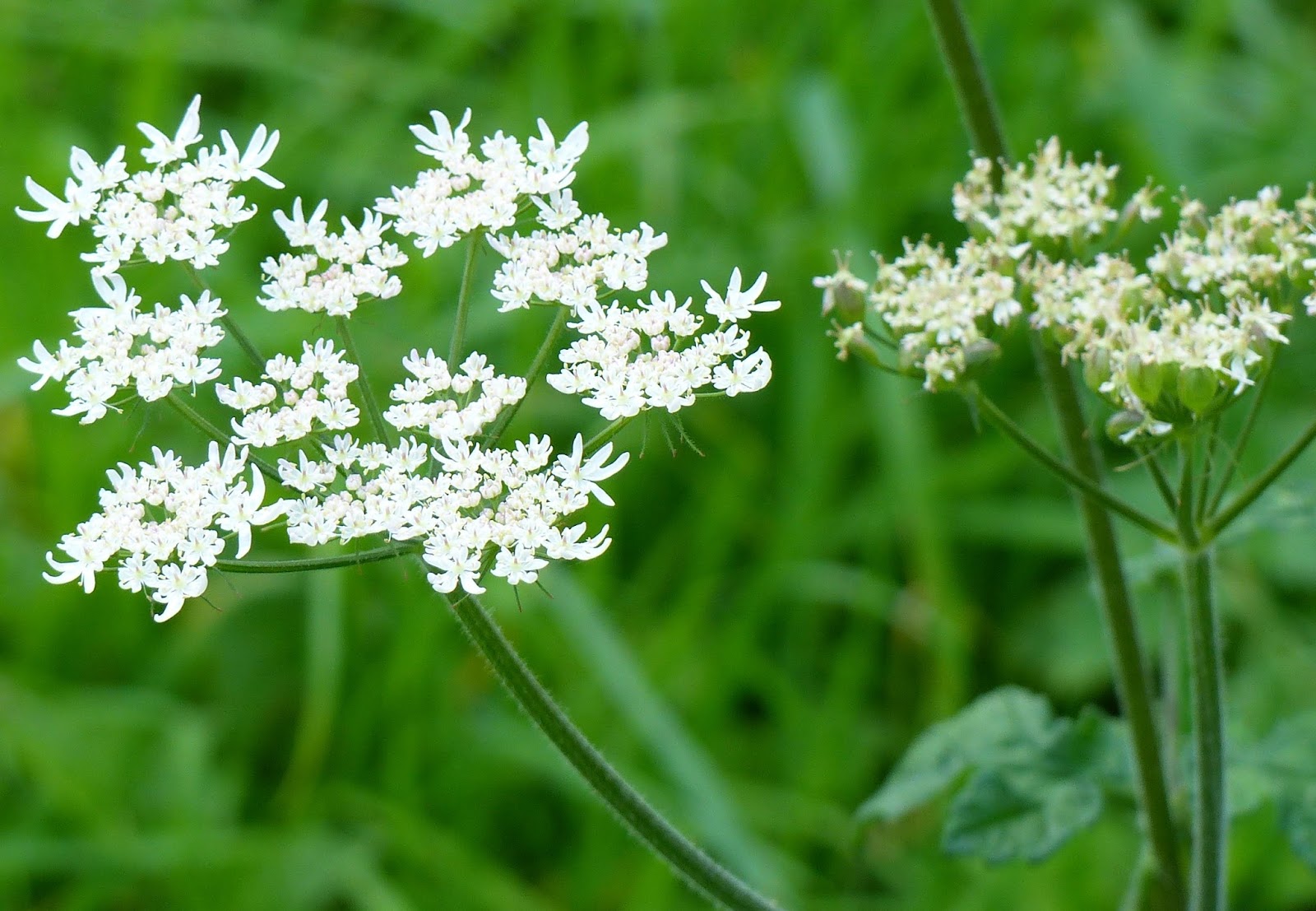
There aren't many flowers left in the meadow now but there are still some to be seen. I took these photos on Saturday morning (17th Oct). During the summer I went on a flower walk led by Tony Smith of Bristol Naturalists and he very ably named the many flowers that we saw. Unfortunately I can't remember the names of some of them but there is clover, buttercup, convolvulus and ivy amongst these. There is a lot of ivy in Badock's Wood and it is a very important source of bird food in mid to late winter. You can see that it is in flower now (bottom flower on the left) and later it will form black berries which will be ripe when many of the other berries will have already been eaten and food for birds and small mammals will be in short supply.


To find out more about the Bristol Naturalists' Society, what they do by way of education and also to monitor and to conserve our environment click here.


Redwings have already started to arrive from Northern Europe. Through the winter they will be seen around Bristol, often with Fieldfares, feeding in flocks on Rowan and other berries. As the winter progresses this food source will gradually be used up and the ivy berries will be important for these birds as well as other berry eating birds such as blackbirds and robins. Although These birds can also eat insects and worms, there won't be many available in the winter. The Redwings and Fieldfares will return to Northern Europe in March and April.
Both birds are types of thrush. The redwing with the red under the wing and the fieldfare with the distinctive grey around the head and tail. You might see them in the trees of the meadow. These photos are from the RSPB website. For more information on these and other birds  click here.
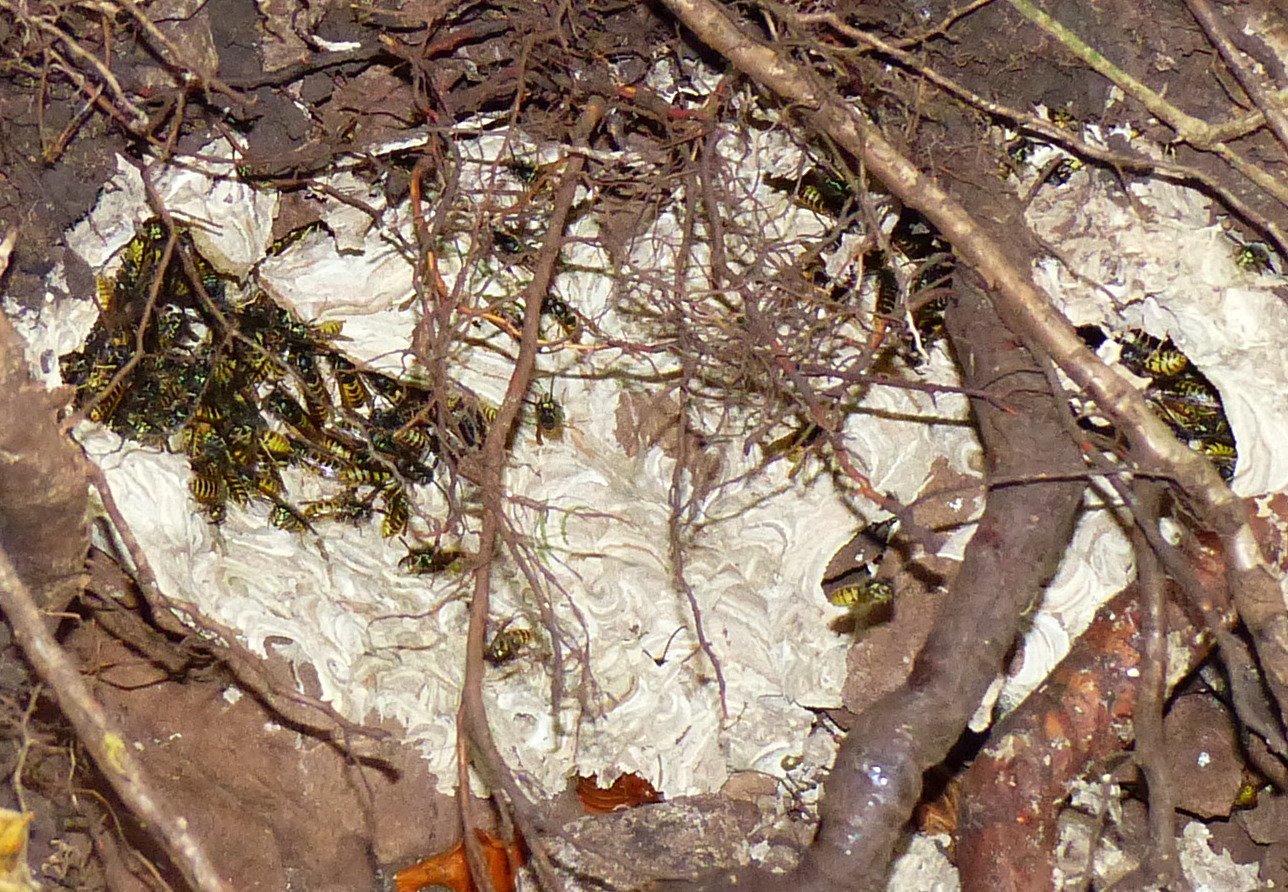

This warning has appeared over the last few days and can be seen on the Triangle. Wasps of course are a natural part of the wildlife of the wood but also can be major inconvenience. I took this photo of the nest early on Saturday morning and the wasps didn't cause me any problem at all. I could get very close and they didn't take any notice of me. They didn't see me as a threat. Unfortunately I didn't take a photo of the sign at the same time. I went back with my wife later in the afternoon to take this photo of the sign and the wasps had clearly been upset through the day and one got into my wife's hair and stung her on the head as we tried to remove it. She was several metres from the nest. Fortunately not a serious problem and antihistamine cream relieved the discomfort. I had one in my hair but it came out without stinging. I don't know what will be done to reduce the danger. It seems  a shame to destroy the nest but it is beside one of the major paths in the wood and children are certainly at risk. I expect it will be the Council's decision and they will have to consider the risks to people which include the possibility of anaphylactic shock. In the meantime make a detour when you see the sign.  I'll copy a paragraph about the life history of wasps from a website and paste it below....................

"At the end of the summer, the wasp colony takes on a different function. The queen now starts to lay 'different' eggs. These will eventually emerge as males (drones) and new young queens. The activity becomes 'very active' and the workers are super protective about their nest.
The young queens mate with several drones to become fertilized for the following year.
Eventually the whole colony dies off apart from the new queens who like the queens before them, find a suitable place to hibernate for the winter."

For more information about wasps from the website click here.


This is an entrance into Badock's Wood from Doncaster Road. Perhaps not as well known as the main Doncaster Road entrance but the trees here can be very colourful. The lane is about a hundred or so metres long before it opens out into the wood beside the Trym. One side of the lane has houses and the other side has a fenced off wooded area which is inaccessible from Badock's Wood.


Enjoy your walks in the wood but watch out for the wasps !!


If you have any comments please send them to me at: badockswood@virginmedia.com .

If you would like notification of future posts enter your email address in the box at the top right of page.

mike townsend


Sunday, 11 October 2015

A Walk on The Dark Side


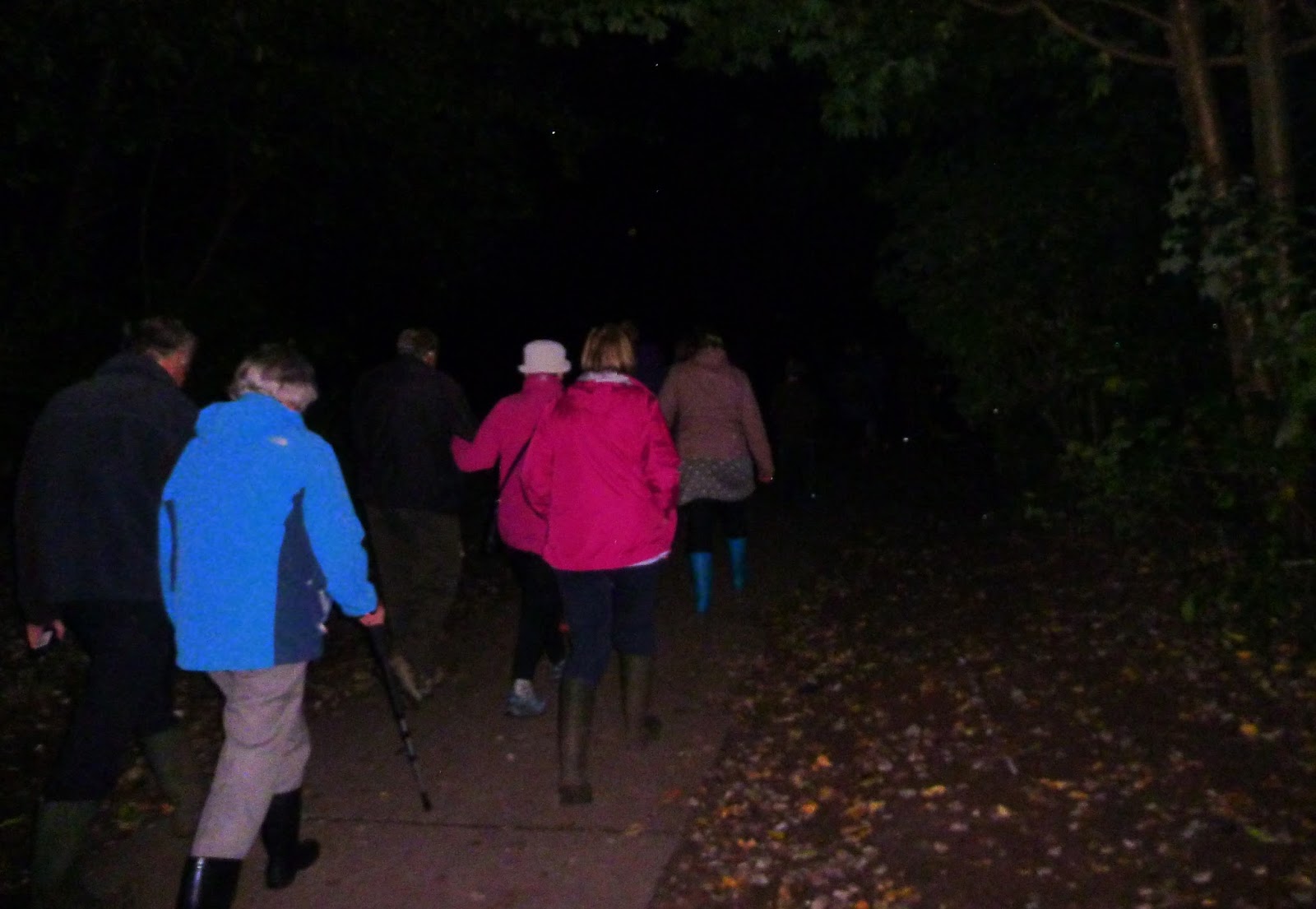
 Badock's Wood can be very atmospheric in the evening. Dramatic cloud formations and the sun shining through and reflecting off the clouds; the warm colours changing by the minute. There is also a clamour of calls from the crows and jackdaws returning to their roosting sites high in the trees and perhaps squabbling over the most comfortable perches before settling down for the night. It certainly sounds as though there's a quarrel going on. There is also a certain eeriness about being in the woods in the evening as night time gradually closes in.
It might seem odd to say that the Owl Prowl was a great success, when in fact we didn't hear any owls. But this was more than compensated for by the interesting mini-talks given to us by our guides from the South Glos Group of the Hawk and Owl Trust as we walked through the woods by torchlight. There were plenty of other woodland night time noises to hear and wonder at. I was interested to learn that owls can 'lock' their talons so that they can grip their prey without tiring or expending much energy.


At the end of the evening we were treated to an appearance by a tawny owl and a barn owl brought by our guides. They are beautiful creatures and even attracted the attention of several passers-by who hadn't been on the walk. Watch the FOBW website for the next Owl Prowl, perhaps in the Spring, it's a marvellous experience. Thank you to Dave Knowles and Paul Golledge of the Hawk & Owl Trust for leading us and for bringing the owls. To find out more about the Hawk and Owl Trust click here.

On Tuesday 6th Oct I walked around Badock Wood with Sian, also of FOBW and Matt Collis of The Avon Wildlife Trust. He was giving us advice on the siting of bird nesting boxes. For the moment we are mainly interested in placing boxes suitable for  bluetits and great tits and also nuthatches. Of course other birds might use the boxes but robins and wrens usually prefer open fronted boxes and also to be nearer the ground. The placing of boxes needs care because the birds require safety from predators, including sparrow hawks, and also from the elements. For this reason we will try to place them 3-4 metres from the ground and facing between North & East. We will also be getting advice from the Hawk & Owl Trust about placing new owl boxes because the present ones are much too high.
Matt Collis is leading a project aimed at helping groups across the city improve their local areas for wildlife. This includes wild flowers, birds, insects and many other species. Having these areas of natural beauty and interest is vital to our own physical and mental well being. It is well worth looking at The Avon Wildlife Trust site to see what is happening around Bristol. click here to read more.
While we were walking around with Matt we were surprised at how quickly the fungi had grown on the Chestnut bench in the wood. Nothing to see on Sunday but by Tuesday morning I was able to take these photos. Thank you Matt.

Entrances to Badock's Wood

I usually go in and out of the wood via the entrance opposite the Willowbank Residential Home  in Lakewood Road. It occurred to me that most of us would use just one or two entrances and perhaps never see the others. This entrance is at the far end of Lakewood Road and leads to a path on the south side of the Trym. The path along that side of the stream can be very muddy and there are some steps which can be slippery to come down if you wish to walk right along to the triangle. However the first part of the track from the Doncaster Road end is not muddy and worth a wander.

Badock's Wood Celebration 2015


These are some of the photos from the Badock's Wood celebration on 20th September. Down the left side there is: Friends of Badock's Wood, Festival of Nature, Specialised Nestboxes and A Bristol Murmuration.


Down the right side we have Bristol & Avon Rivers Trust (BART), Mutty Professor and Avon Wildlife Trust.
Links to the various organisations can be found below. It was a very successful day and more than two hundred people came to find out more about the all aspects of the wood .


 Friends of Badock's Wood
Festival of Nature
Specialised Nestboxes
Bristol Murmuration
Bristol Avon Rivers Trust
Mutty Professor
Avon Wildlife Trust


 One for sorrow, two for joy

A group of magpies is sometimes called a 'tiding' but what tidings can we deduce from this number of birds? They can be seen on most evenings gathering on the short grass of the meadow and presumably feeding on some small creatures.

Even on damp days it can be very pleasant just to wander through the woods, perhaps looking at nothing in particular but absorbing the calm and peaceful atmosphere.


You can click on the photos to enlarge.
If you wish to be informed of future posts put your email address in the box at the top right of the page,

Comments can be sent to: badockswood@virginmedia.com

mike townsend


Monday, 5 October 2015

Prefabs & Fungi

It was a misty morning on Sunday 4th Oct. A perfect start to the day. The sun was giving warmth and clearing away the mist. Several walkers were enjoying what many believe is the best part of the day; and Sunday is a day to relax.

However, it wasn't the same in post-war Bristol. During the Second World War nearly 82,000 Bristol homes were completely destroyed by enemy bombing and nearly 1300 Bristolians were killed and many severely injured. Because of this the council temporarily broke Sir Stanley Badock's covenant forbidding building in the wood and allowed the erection of 81 prefabs in May 1947 on the meadow. The road leading to the new settlement was called Bowness Gardens and the prefabs were removed between 1979 and 1982. Some evidence of the buildings still remain in the form of concrete bases and paths. For more information and a photo click here.

I have fond memories from a childhood in Devon of looking for field mushrooms with my brothers and cousins. Early on chilly autumn mornings we would go collecting and then have a delicious breakfast of cooked mushrooms.

 However, there are many different shapes and sizes of fungi and several of these can be found in the wood. 
I don't know the names of them but I do find them fascinating and these photos have been taken recently as I walked around the wood. They have their individual preferences for live trees, leaf mould or decaying wood. Often they are not immediately noticeable so peer into the undergrowth or around a dead tree trunk and see what you can find. I have no idea which ones are edible and which ones are not and so I would not even think about eating any of them.


Sunday morning I also met a lady who was walking with her friends. She had prepared a Nature Trail for them and they were walking around Badock's Wood looking for the landmarks in the photos that she had printed off for them. The children were having a great time.
 Not an original idea of course but it was the fact that she had  actually done it that impressed me. Well done !!  I took a photo of her trail sheet and there is one picture on it that I can't place so I will have to have a search around the wood for it myself.


 The black spots on these sycamore or maple leaves are also caused by a fungus. You will find many examples of this through the wood. They are called 'tar spots' and look unsightly but don't cause the tree any substantial harm. The spots gradually increase in size and intensity through the summer but the leaf has already done its work of supplying the tree with food by photosynthesis using carbon dioxide and sunlight. Soon the tree will cut off its connection to the leaves and they will fall as they do every autumn.

This oak apple is feeding a wasp larva. The wasp lays an egg in a leaf bud, this causes irritation and forms a swelling, the gall, with the larva inside. When the larva hatches from the egg it feeds on the inside of the oak apple and develops into an adult wasp.
There are several types of gall wasp and some will lay an egg in an acorn to produce a distorted fruit. You will then see a very peculiar acorn which cannot develop into a plant.
 I had just passed the carved bench, towards Lakewood Road when I noticed this crow working very hard at getting something out or off of this piece of bark. Whether it was insects or moss that it after I really don't know. It carried the bark from the tree to the path, then back to the tree again before flying off with it. The crow was determined to get as much as it could from the piece of bark.

This magpie had a much better idea. It was sitting in the sun at the top of a tree by the sports field and just watching the world go by.....  a perfect Sunday !!


~~~~~~~~~~~~~~~~~~~~~~~~~~~~~~~~~~~~~~~~
There's an Owl Prowl on Thursday 8th October from 7.00–8.30pm.  Meet at Northern Gateway, Doncaster Rd. To check for updates see FOBW website: click here.

Click on photos to enlarge them.

 If you would like notification of new posts to this blog put your email address in the box at the top of the page.


Comments can be sent to: badockswood@virginmedia.com

mike townsend

Monday, 28 September 2015

Wings and the Web

 I enjoyed the tree-walk at the Celebration Day last Sunday. I thought that elm trees had been wiped out by Dutch elm disease but we were told that there is elm present in the woods.  There are no mature trees but the old roots have survived and send up suckers to form new saplings. There is a cycle of the old roots sending up suckers, after several years these succumb to the disease and die but then new suckers come up. We were told that the disease appears to be getting less virulent and hopefully eventually will be weakened enough for the suckers to survive and produce new healthy mature trees.
 The seed on the left is the elm, it has a wing encircling it. This photo is from the internet, the others are from Badock's Wood. The one on
the right is sycamore which children love to throw in the air as helicopters when they are brown and dry. It's interesting that the sycamore seeds are sparse in Badock's this year but the ash keys (below left) are very abundant as you can see. Last year the situation was reversed and apparently no one knows why this happens. Lime keys on the right. When you see these do not park under the tree because the tree drips a very sticky sap that will make a mess of your car.
The variously shaped wings are devices for catching the wind and they spread the seeds as far as possible from the parent tree to give the maximum chance of a new tree growing to maturity.


  Last Sunday, 20th September, I was watching this squirrel searching for and eating acorns under the large oak trees at the Triangle. It was having quite a feast but it suddenly disappeared up the tree. Quite sensibly because when I looked to see what had happened there was a large fox standing close to where the squirrel had been.


 Its eyes were fixed on me but by the time I'd pointed the camera it was well on its way and The lower photo was the result; just a bushy tail and a rear end. It was a good looking animal and almost certainly a dog fox because of its size.


There are all sorts of creatures in the wood. We found this caterpillar on a trunk during the tree walk last week. It is from the lime hawk moth which flies in may & June. It feeds on lime but also on other deciduous trees too. I'm embarrassed to say that it reminded me of a unicorn but I later discovered that the horn is on the rear end. The caterpillar is green at first but becomes brownish like this as they prepare to pupate for the winter.  It was about 6 or 7 cms long. I shall be looking out for hawk moths next year.


Spiders often get a bad press so I've put this one in because he seemed quite a handsome fellow. Its body is about 2 cms long. He was busy building his web to catch unsuspecting flies and moths. I am told that he is a common garden spider. If you enlarge the photo by clicking on it you will see that the legs are very spiny, presumably to assist in gripping its trapped prey or in climbing over the web. Most spiders have 3 sets of spinnerets to produce the web and these produce different types of silk.  Some sticky and some fluffy to capture prey and also a single thread silk for the spider to hang from.

I saw a heron at the pond a few weeks ago and I wondered if it had found a sizable fish for its meal. I thought that perhaps someone had put in a carp that had outgrown the owner's pond. However, I was surprised to find a small shoal of fish in the pond this afternoon. You can see that there are about a dozen and they are about 7 cms long. They soon vanished into the murky water, probably thinking I was a predator so I would think that a heron would have difficulty to catch any more than one fish at each visit. I don't know what type they are.

 The Willow Bank Bench (left), another of Andy O'Neill's sculptures, was officially opened by the Lord Mayor in March 2015. It shows Hidden Green Treasures within the wood and has a magnificent owl with spread wings across the top of the back. It is worth a visit to see the other animals and wildlife that have been sculpted into the sides of the bench and under the arm rests. Of course the bench has weathered since March and its wood is now much darker.


The bench is conveniently placed between the Triangle and the Lakewood Road entrance where the Willow Bank sheltered housing is situated. It gives a good view along the path and the stream. You can just make it out in the centre of this photo.
 If you would like to receive notification of each update to this blog, please put your email address in the box at the top right.
You can enlarge the photos by clicking on them.

Remember:  
Thursday 8th October 7.00 – 8.30 p.m. Owl Prowl. Meet at Northern Gateway, Doncaster Rd.
For more information see: Friends of Badock's Wood Website

 Comments can be sent to: badockswood@virginmedia.com


mike townsend