Sunday, 29 November 2015

Preparing for Winter


It was cold and frosty in the wood on Monday 23rd Nov. But it was worth getting up and out early to see the sunrise over the meadow and trees.
In some respects it's easier to see birds at this time of year. Because the days are very cold the birds have a higher food requirement and because the days are shorter they have fewer daylight hours to find that food. Their focus is on survival.


The day before, I was walking with my wife and we saw a pair of Great Spotted Woodpeckers in the trees by the Willowbank bench. They might have been males negotiating over territory or they could have been a male and female deciding if they would make a good couple. I managed to take a photo of one of them. The red patch on the back of the neck shows that it is a male but both sexes have the red under the tail. They don't normally start drumming until about January and then go on until  early summer. You might hear them sooner because they also have a high pitch short call, but for drumming and an interesting piece of RSPB video click here.
You might notice in the video that the young bird has a red patch on the forehead. This disappears with the first year's moult. To hear the call click here, then click on the 'white on brown' play symbol. This web site, xeno-canto, is excellent for all sorts of bird calls from all over the world. It's well worth coming back and playing with it for a while.
Goldcrest in Badock's Wood - beside the Trym.

During that same walk we saw a pair of treecreepers by the Trym, goldcrests and long-tailed tits and a grey wagtail. Mostly they were too busy to take much notice of us. If you'd like to see pictures of these various birds and hear their calls go to the RSPB website and click on the letters to select the birds. See: RSPB.
 I know I put in a photo recently but the goldcrests are so special that I'm adding the bird I saw on Thursday (26th), while I was talking to Graham and Linda.

Alder catkins and fruits (Badock's Wood meadow)
 I have always associated catkins with spring...Hazel catkins looking like lambs' tails. However, as I walk around the woods I see that there are plenty of catkins already and on various types of tree. They aren't ripe yet, in that they aren't 'dusty' and producing pollen. That's just as well because there aren't any female flowers to receive the pollen, it would just blow away in the wind, to no effect. No, the catkins are tight and waiting for Spring.
Hazel catkins (Badock's Wood meadow)
 In the photo of Alder there are green unripe catkins as well as  green fruits. The fruits have come from green flowers, which have been pollinated this Spring and will become woody like cones and release their seeds next Spring. The woody cones that you can see were pollinated last year and released their seed this Spring, perhaps producing more alder but also feeding the birds.
The Hazel catkins beneath it will produce pollen next Spring too and pollinate small red flowers to produce the familiar nuts that are the favourite of squirrels, woodpeckers and humans.
Similar catkins are also found on birch and poplar.


It was a completely different sort of morning yesterday (28th). It was wet, windy and pretty wild, when the intrepid FOBW work party, led by Siân, took up saws and loppers to fell the sycamore saplings along the stream from Willowbank to the Triangle. There were 5 of us and although we got wet we didn't get drenched. However, it was very slippery on the steep slopes and there were a couple of tumbles but generally it went very well and without incident. Unfortunately we left with one fewer pairs of tree loppers than when we arrived, so if you see any on your walks in the wood please retrieve them and contact the Friends of Badock's Wood via their website: FOBW.

There is a problem with garden waste being thrown over garden fences into the wood and there's a misconception that the rubbish will just decompose and no harm will be done. Unfortunately this is not the case. It prevents the growth of natural plants by smothering them as well as sometimes containing weedkiller or other chemicals. As the pile builds it might fall or be washed down the steep bank and look unsightly and even possibly dangerous.
It's an eye-opener to think that this is no different than driving 10 miles and leaving it in the countryside. It's just easier and quicker and of course it saves having to pay the council to take it away. I'm sure those who do it don't mean any harm but it is harmful just the same.... and illegal. If in any doubt click here. 

 At last the bird boxes are up. It has taken a while to plan and organise but last week the FOBW
installed 20 bird boxes suitable for tits, nuthatches and other small birds. These won't be suitable for robins or wrens who like open-fronted boxes and to be nearer the ground but  accommodation for them will be considered another time.
There were already several boxes around the wood but they are becoming dilapidated although at least a couple were still being used by bluetits this Spring. The photo shows Keith of Specialised Nest Boxes putting a box up by the Triangle.
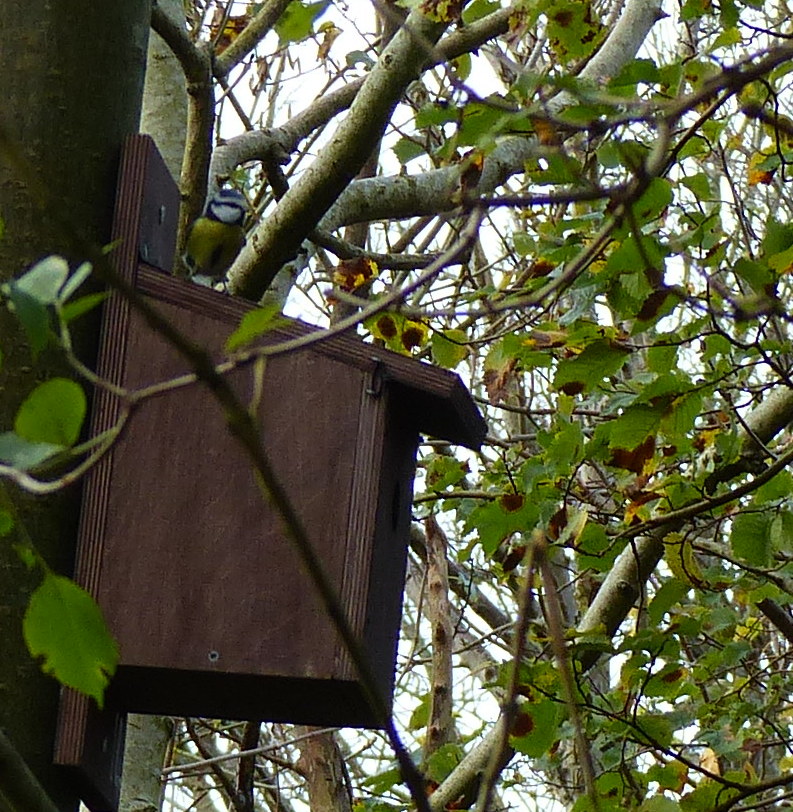


The morning after we put them up I was able to take a photo of a bluetit inspecting the new premises but I think it will find security a problem. The box it was looking at was 32mm and bluetits prefer 25mm so that  larger birds can't get in. We placed several 25 and 28mm as well as the 32mm, so it shouldn't have any problem finding suitable accommodation.
Keith of Specialised Nest Boxes of Charterhouse, Somerset made the bird boxes and he and his wife, Linda, supply several wildlife and conservation groups. If you'd like to know more about them click here.


You can enlarge photos by clicking on them.

NOTES:

   The Friends of Badock's Wood Quarterly meeting will take place at the Greenway Centre, Doncaster Road on Tuesday 1st December at 7.30pm. Everyone is welcome to hear what is planned for the wood and will have a chance to voice their opinion.

    There will be a Litter Pick on Friday December 11th, 2.15 - 3.30pm. We will meet at the Doncaster Road entrance. Equipment and gloves will be provided but do bring your own if you have them. Please email fobwsecretary@yahoo.co.uk if you plan to take part in the Litter Pick.

    Tree Dressing - There will be a Celebration of our Winter Trees on Sunday December 13th at
2 -3.30pm. It will be near the Doncaster Road entrance. See posters around the wood for more information.

 Add your email address to the box at top right of page to receive notification of future posts.

 You can comment on anything in the blog or contact me at badockswood@virginmedia.com

mike townsend


Friday, 20 November 2015

Learning? - Start young, then never stop !!


 It's been very windy with heavy rain over the last few days. Tuesday afternoon (18th Nov), the rain had stopped so I went to the wood about 4pm. Already it was dimpsy and still very windy. I was a bit nervous of falling branches as I walked under the trees by the Triangle but it was exhilarating to hear the wind rush through the trees and to see them sway above, even the oaks.
I was relieved to get to the meadow and be able to feel the wind out in the open. I was able to watch crows and wood pigeons hurrying back to their roosts but being blown in all directions at the mercy of the wind. Unfortunately the photos give no sense of the wind.
It became dark very quickly and this photo(left) shows Southmead Hospital at its centre and the children's sports pitch on the left. It is taken from the Ceramic Circle near the main Doncaster Road entrance.
It wasn't an evening when most people would walk for pleasure but there were a few taking their dogs for an early evening walk.


Looking into the meadow from Doncaster Road
Even at about 5pm it was quite dark when I left by the Doncaster Road main entrance and it had just started to rain. I don't feel comfortable walking alone through the woods in the dark so I walked back via Lake Road. (Little Red Riding Hood Syndrome?

The wind was even stronger during that night and the rain heavier.


 Next morning we found a tree, a Field Maple, across the path that leads from the Lakewood Road entrance towards the Triangle. Unfortunately, it is the same tree that the Sparrowhawks chose to nest in during the Spring. Hopefully, they will find another suitable tree somewhere in the wood. There was a lot of ivy on the tree and that combined with the shallow root system on the slope contributed to the tree's susceptibility to the wind.
Below is one of the Sparrowhawk chicks shortly before it left the nest site in July.
There's a photo of one of its parents in an earlier post. Although these birds eat the smaller birds such as tits and sparrows, it helps to maintain a delicate balance. If the sparrows had no predators then they might increase in numbers to an extent where they actually become a pest as they are in North America. It is dangerous and unwise to interfere with the balance of nature. In 1958 the Chinese tried to eradicate sparrows because they were eating their rice crops.  They didn't realise that the sparrows also ate destructive insects and so rice yields actually fell. So beware of eco-engineering. To read more about the Chinese sparrow eradication campaign click here.
 You might notice that the sparrow in the Chinese experience is the Tree Sparrow. This has a brown cap rather than the grey cap of the House Sparrow which is the sparrow we commonly see. I saw the Tree Sparrows on the left at Rutland Water in 2014. It was a common bird in the UK up until the 1970's but is now absent from the South West. It has fallen by an incredible 93% since then but there are now signs that numbers might be slowly creeping up again. It is a lovely bird and can be seen in the Midlands, southern and eastern England. There's a nice piece of video on the RSPB website:  Click here. Also on YouTube: here.

 .


Anyway, I continued from the fallen Maple tree to the area of fallen logs and the Story Teller near the Westbury Wildlife Park. We had a lovely surprise ( I was with my wife) because there was a group of young children enjoying the wood and learning about it at the same time. We learned that this was the Badgers Forest School Bristol run by Jenny Sanderson. I was quite taken by one young man who was offering Jenny a fragment of biscuit. He was so insistent and kind, wanting to share. Unfortunately he dropped it in the mud but it was the thought that counts. If you'd like to know more about the Badgers Forest School you can view the website by clicking here. They were so fortunate with the weather because it had been raining most of the night and soon after school was over, it started to rain again. Well, it is autumn !!

Siân is leading a Friends of Badock's Wood work party, organised for Saturday 28th November at 10am for a couple of hours. We'll be cutting back some of the Sycamore saplings that are invading along the edge of the stream and along the path leading down from the Lakewood Road entrance. If the saplings are allowed to grow they will prevent those smaller plants and shrubs growing close to the ground which would otherwise protect the banks and encourage insects, birds and small mammals. If you feel able to help on this day then drop a line to fobwsecretary@yahoo.co.uk and ask to be added to the group. You can do as much or as little as you want or feel able. Some tools and gloves will be provided but if you have your own you could bring them along. It should be a good morning.


Notes:

If you would like to know more about the Friends of Badock's Wood  click here.

Click on the photos to enlarge them.

Add your email address to the box at top right of page to receive notification of future posts.

If you would like to comment or ask questions about the blog you can contact me at: badockswood@virginmedia.com

mike townsend


Sunday, 15 November 2015

Wet, Wet, Wet -- No, not them !!

         If you're disappointed that I wasn't referring to the group of singers called Wet Wet Wet here is a YouTube link to one of their songs which is easy listening and perhaps vaguely relevant to the woods.. click here for song.
        But no, I was referring to the watery type of 'wet'. I got wet on three separate occasions this week but none of it was unpleasant.
First Wetting.  It all started on Wednesday, but this time I got into the stream wearing wellingtons so I was ok.
 At last we were choosing a part of the River Trym within Badock's Wood to monitor for fly larvae. This will give us an insight into the quality of the water in the river. The part we selected because of ease of access and water flow is just below the weir where the two streams join. On this trial occasion we found many water shrimps but only one mayfly larva. This is disappointing because we would expect to find larvae of perhaps 5 different types of water fly. These might be caddis fly, stonefly and types of olives as well as the ones that we did find. Once the site is registered with Bristol Avon Rivers Trust (BART) we will start official monthly recordings and these will be entered on a database along with records from other waterways across the country. If you'd like to know more about BART and the work they do click here.
If you would like to see some pictures of riverfly larvae on Google Images click here.

Crystal Brain fungus


Second Wetting. On Friday I got very wet. This time we were looking for fungi in the woods. Ruth Revell, who I'd met at the Riverfly training in Calne and who is a fungus enthusiast had offered to lead an informal fungus foray in the woods. It had rained all night and the forecast was not good but the call of the woods was strong. There were five of us and despite being rather late in the season we recorded at least 13 different types including candle-snuff, turkey tail and King Alfred's cakes but one of my favourites is Crystal Brai.

King Alfred (The Great) is reported to have burnt some cakes while taking refuge from the Vikings in the Somerset Levels around AD 880 and the hard, woody fungus (burnt cake) on the left is a reminder. It is very woody and has rings similar to a tree on the underside. (See above right)
Although it was light rain or dry most of the time we did have a downpour while we were by the bridge near the Westbury Wildlife Park which caused a torrent to flow down the chute. Normally this is completely dry or at most a trickle. As often happens, after the downpour the sun came out as can be seen in the photo on the right. Where does this water come from?
The Sportsfield is at the top of the rise and there are houses to the left of that so the water might flow from the drains which collect the rain near the houses. Drains are one way that toxic liquids can get into the river and poison the riverfly and other creatures.
Waxcap fungus
Blewit fungus
 In the woods we saw mostly woody bracket fungi such as the turkey tail and southern bracket but not many typical 'mushroom types' with caps, which were present in October (see previous posting). However, we did see Fairy Bonnet and Glistening Inkcap. In the meadow, near the pond, we also saw a fairy ring with both Blewit and Waxcap species close together and I've put two of the photos I took of these to show that the pattern of the gills are quite different. The spores, which are the equivalent of seeds fall from these gills. It is interesting to lay various fungi, gill-side down on a waxed piece of paper. After a couple of days the spores will have fallen onto the paper and made pictures of different patterns and colours. Purples, white, oranges and browns. Warming the paper will fix the spores in place. I haven't done this since my girls were young but I must do it again next year with my granddaughters.


3rd Wetting. I went out again on Saturday morning (Nov 14th) .... remember the wind and rain? It was touch & go but we went anyway. I was with Matt Hobbs (ecologist) and we were selecting trees suitable for placing bird boxes. We did get very wet but we were dressed for the occasion. These boxes will be suitable for tits of various types as well as nuthatches. The boxes and their placing will be paid for by a donation from a member of the public. While we were in the wood we saw large flocks of long tailed tits and also several more goldcrests (see previous posting).
I was surprised to be told that blue tits and wood pigeons also move around in large flocks. They might not travel such large distances as swifts or cuckoos but do move around the country and possibly go overseas. Their migratory patterns have not been studied as much as some others and so is a mystery waiting to be solved. There are a couple of YouTube clips and a newspaper report that are worth looking at. The bluetit flock is passing through Sweden but the pigeons were in Portland, Dorset a few days ago. See: blue tit migration.  wood pigeon migration   newspaper report on wood pigeon migration.

I saw this jay in the woods in September. They are very colourful birds of the crow family. They eat the eggs and young of other birds in season but during autumn one bird can hoard about 2000 acorns for the lean times of winter. It's reported that most of these will be recovered and eaten but some will be left and perhaps grow into new trees. They are members of the crow family and learn quickly. Birds of the crow family are called corvids and as well as the jay they include magpie, crow, jackdaw and raven. All of these can be seen in the wood or over the meadow. Rooks are corvids but are not often seen in parks or woodland within large urban areas.
Female blackbird harvesting in September


The Friends of Badock's Wood (FOBW) have an open meeting four times a year. The next one is on Tuesday December 1st at 7.30pm in the Greenway Centre. It is open to anyone who is interested in the management and conservation of Badock's Wood. If you would like to hear what is happening and perhaps give your opinion on what happens next, then just come along. You will be made very welcome. To lean more about FOBW click here.


NOTE:

You can click on photos to enlarge them.

If you wish to receive notification of future editions then put your email address in the box at the top right of the page.

If you wish to comment on the content of this blog you can contact me at: badockswood@virginmedia.com

mike townsend


Saturday, 7 November 2015

Nevermind the Weather...

      It was wet and drizzly when I went to the wood this morning (5th Nov). Surprisingly, the rain made the colours richer and more interesting. However, I was reminded of snow as it turns to slush. A week or two ago the leaves were crisp and light, fun to kick. Now some have turned to 'slush' and in places are quite slippery underfoot. I'm told that there was a time when the council came to blow the leaves away from the paths but with the cutbacks those times have gone. We could give some thought to volunteers clearing the paths in future years but there are a lot of paths and a lot of leaves!!  If it's done when the leaves are dry they might just blow back but if it's done when the leaves are wet and 'slushy' then the paths might be left more slippery.
As I walked to the woods the streets seemed quite damp and dreary but in the wood it all changed and although still very damp there was no dreariness, the stream was lively and there was lots of interest all around. It's unfortunate from a wildlife point of view but some will be relieved to know that the wasp nest has been 'treated'. Unfortunately the wasps had become too aggressive and several people had been stung. It was mentioned previously that wasps become very protective of their nest and queen in Autumn and on this occasion it has led to their downfall and the death of their queen.
Autumn is a time when many birds move to warmer areas. Some come to us from farther north, perhaps from northern Britain or the north of Europe where it has got much colder. Others feel that it is too cold here and leave us to go south and head for the warmer parts of Europe or Africa. The Goldcrest is one bird that arrives in the UK for the winter and its high pitched call can be heard in the wood.  Some stay throughout the year but it is likely that the population actually doubles over the winter. The other day I was listening to a flock of Long Tailed Tits and I was told, by someone who knows (thank you Matt), that there were Goldcrest calls amongst the Tit calls. They are very small birds, in fact the smallest bird in Europe. They weigh about 6 gms which is approximately half the weight of a wren and the same as a 10 pence piece. It is a very pretty bird but difficult to see clearly because it is forever on the move. They are seen in the woods through the year but I haven't managed to get a satisfactory photo. I will use a photo I took at Sea Mills in 2013, fortunate that it perched still for several seconds. You can see the gold strip on its head and such fragile legs. Tits of various types forage together in the winter and the Goldcrests often stay with them. This offers extra security  because there are then more eyes looking for predators at a time when the birds might be weak or slow because of cold and shortage of food and the leaf-fall leaves them more exposed.
I've put this second photo in because it is a Badock's Bird. It proves that there are Goldcrests in the wood. I took this photo in the Spring. You can see that this bird is well hidden and protected by prickly holly but often they prefer conifers. If you hear a very high pitch call then look up to see whether you can see this very active, tiny bird or whether it is the call of a long-tailed tit like the one below.


This is a Long-tailed tit that I saw in Badock's Wood meadow in July. They are very agile and it was hanging on the plant but I have rotated the photo clockwise by 90° to make it easier on the eye and brain. They are usually in groups and the long tail is  a distinguishing feature.


Mosses, like the one on the left are very interesting plants. I was surprised to learn that there are about 20,000 species of moss. I don't know how many different ones there are in the wood but it would be interesting to find out. Often it is a soft, rich green cushion on a fallen trunk or on the bank of the stream and can look very attractive. The life of moss is a bit complicated but if you would like to know more click here.
  
The story of lichen is even more confusing because it is formed when a fungus joins with an alga and they live alongside each other and support each other. Algae range from very simple forms like the blue-green algae which can be single cells or fine strands in streams and ponds, which we saw in the stream a few weeks ago, to the much larger forms such as the sea weeds like kelp and the ones we find on a beach. The fungus and alga are then both changed so that they don't look like either the fungus or the alga. . In fact it is now a lichen. The one on the right is in the wood.


We often see lichen as scales or tufts on twigs and branches but I remember seeing 'matchstick' lichen on Dartmoor although I haven't seen them in Badock's Wood. They are attractive and interesting so I'll put in a photo from the internet. To see on Google Images the wonderful variety that lichen give click here. Or if you'd like to learn a bit more about them click here.


 It's still very wet and windy in the wood today (7th Nov) as I finish the blog so I'm putting in a couple of brighter photos. These were taken in the meadow in October. There is frost on the seat but the colour of the trees lifts the scene.


You can see that even when it's damp or frosty there are good reason to dress up warm and dry and get into the wood. Do take care with the damp leaves though; they can be very slippery, especially on the uneven ground beside the stream.

Postscript:  I went to the woods when the rain stopped this afternoon (7th Nov) and was fortunate to see  a Goldcrest and its orange crest very clearly. This was the first I'd seen clearly since the Spring. Unfortunately I wasn't able to get a photo. I should say that it appeared to be alone and not part of any group but possibly it was on the margins of a group.

If you would like to play a part in looking after Badock's Wood then browse the Friends of Badock's Wood website to join the emailing list. Click here.   You can volunteer to help with collecting the litter or to join the work parties that do important tasks such as clearing invasive plants and coppicing. You would be able to do as much or as little as you feel able. Just comment in the email whether you would like more information about the work parties or about litter collection, or both.

If you would like to comment about any subject relating to Badock's Wood or the blog you can leave a message for me at badockswood@virginmedia.com

To follow this blog and to get notification of future posts put your email address in the box at the top right of the page.

mike townsend


Wednesday, 21 October 2015

Calling all Friends of Badock's Wood !!

Nowadays Badock's Wood  is a very pleasant, natural space. We can enjoy the calm while exploring the wonders of nature. Even if the main reason for the walk is to exercise a dog then there can be no better surroundings and I'm sure the dogs appreciate that as much as we do.
 Twenty years or so ago it was a completely different story as many of you will remember. There was poor maintenance, vandalism by car and motorbike thieves and the burnt out wreckages of their activities were abundant.

The general improvement in the wood has been largely due to the activities of people such as you, within the framework of the Friends of Badock's Wood (FOBW)  working with the council. I'll paste below a piece from the FOBW website about the formation of the group.

In June 2000 a local resident, the late Salim Allibhai, organised a meeting, called in a multitude of local agencies, including the City Council, the Police and the relatively recently formed Friends of Badock's Wood. This meeting started a process of renewal, both of the Woods themselves and of the Friends and by the time of Salim's death, in 2004, the situation in the woods had completely changed. Since that time, the Friends have been closely involved in working with the City Council in producing and implementing management plans for the area, undertaking volunteer work, acquiring grant aid and holding events....
If you would like to read more click here. 

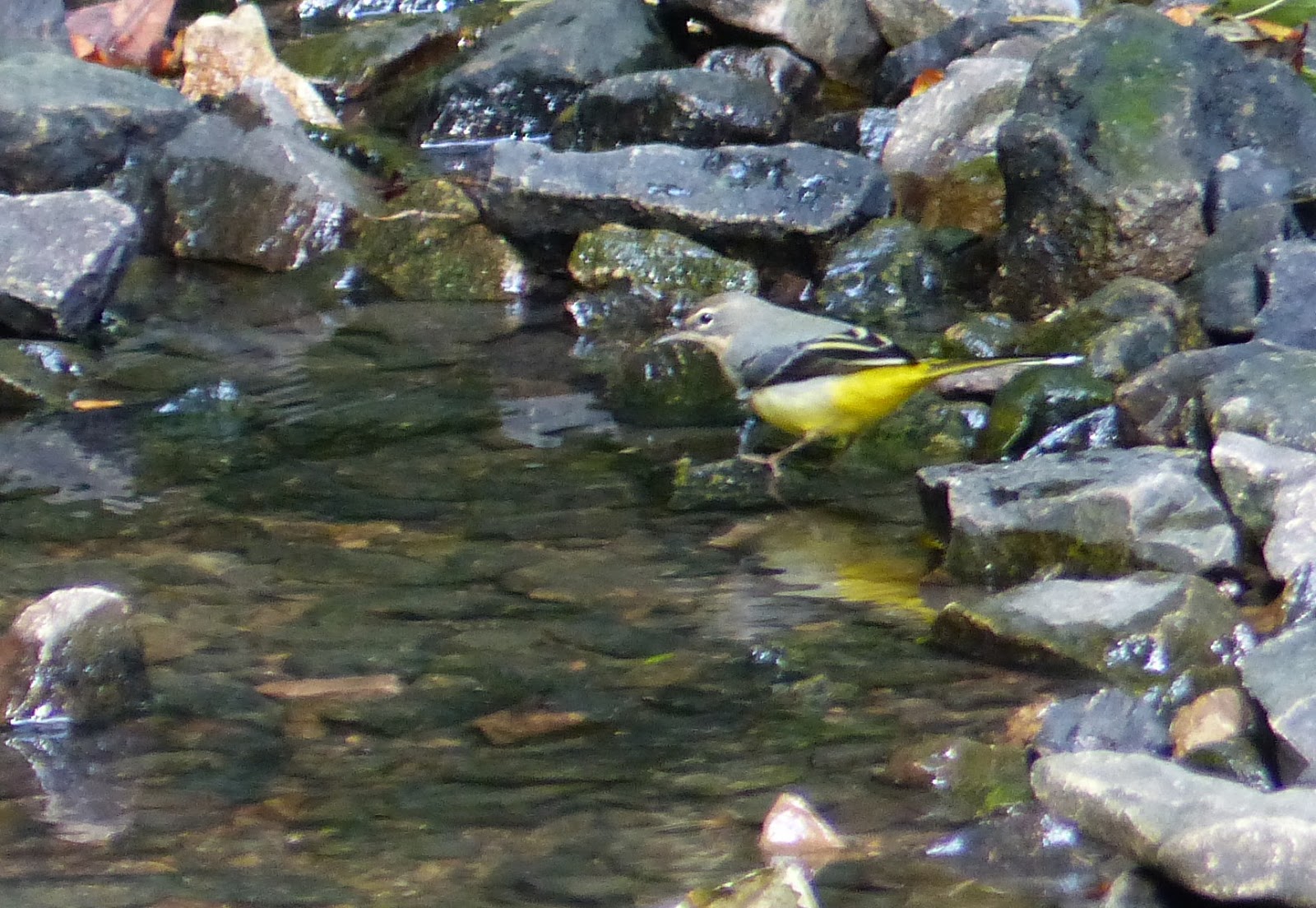
 Not only do the FOBW try to make the wood a better place for us but also for the wildlife. I took the photos of these birds, grey wagtail and great tit in September and these birds are dependant on healthy and vigorous vegetation so that fruit and nuts as well as other seeds can flourish as a food source. The grey wagtail is looking for water creatures which in turn depend on clean water.
 The great tit was making a loud tapping noise as it broke pieces off the nut and the sound could easily be mistaken for that of a woodpecker.

Talking of misleading sound, it is worth mentioning the strange noises that squirrels sometimes make. It can be a churring noise of varying pitches and I find myself wondering what strange bird can be making the noise, only to discover that it's a squirrel warning of my presence or perhaps sending some other message to its neighbours. If you hear an odd noise when you're in the wood just stop and look around. There might very well be a squirrel close by.

Unfortunately the vandalism and thoughtlessness hasn't stopped altogether. Trees are sometimes badly damaged. These photos are evidence of recent damage and it is very difficult to stop.
Two separate trees are involved, the two bottom photos being of the same tree. There might be other incidences throughout the wood but these are two that I've noticed recently.


 As well as vandalism of course there is also litter left around. Fortunately this is easier to deal with than the vandalism. Most of the litter is in the form of drinks cans and bottles but there is a lot of paper and plastic left lying around.
There are two full bags of rubbish which look as though they have been thrown over a fence into the wood from the Clover Ground area. In the same area there is an old television or computer screen, a baby seat as well as other unwanted bits and pieces. Of course they could have been brought from anywhere.  Fortunately they are fairly well hidden by trees but they will be removed by the council when they are informed.


 Another form of thoughtlessness concerns dog mess but fortunately most dog owners are very responsible and we are all grateful to those of you who are diligent in picking up. I know that sometimes the dog litter bins are overfull but I'm sure the council do their best with limited resources.


I've put in this photo of a squirrel as a reminder of warmer days. In fact it was taken in July and the squirrel was snoozing very high up in a tree by the sports field and perhaps sleeping off a morning's feasting on berries and succulent shoots. It might also be tired from a morning's work of hiding food away for the winter but perhaps that comes later when nuts and acorns are abundant. Fortunately it didn't turn over in its sleep. At least, not while I was watching.

Yes, you guessed, I am leading up to something.
If you feel you would like to help with the maintenance of Badock's Wood, and I know many of you do already, please let the group know. FOBW now has dedicated email addresses so that those individuals who organise the various groups within FOBW can reply to you directly.
At present there are three main groups:-
 Litter collection. The FOBW hopes to have a litter collection approximately monthly through the year but being on the list does not mean you will be asked to collect monthly. If there are enough volunteers we will organise a rota, but you can volunteer to do as much or as little as you wish. FOBW will lead and provide information and any necessary equipment.
Work Parties. FOBW also plan to organise regular conservation work parties to manage the woodland and meadow for wildlife. This will include trimming scrub, pruning invasive saplings and plants and hay raking. Of course these activities are dictated by season and weather. Instruction and tools will be provided where necessary.
Bird Group. There are some people within FOBW who are particularly interested in birds. Some members carry out an early morning bird survey approximately fortnightly. Naturally this can't be an accurate record of bird numbers but it keeps us in touch with what is happening with birds in the wood. We don't have formal meetings but we do share with each other if we see something unusual or of interest. All levels of experience welcome.


FOBW would be grateful for your interest and your assistance.
In the first instance please contact: fobwsecretary@yahoo.co.uk .
  • If you are already on the mailing list then write to say which group or groups you are interested in joining.
  • If you are not already on the mailing but would like to be involved then send an email to the above address and ask to be put on the mailing list and mention which group or groups you would like to be part of.
  • If you would like to be on the mailing list but don't feel ready or able to be in a group  then send an email and ask to be put on the mailing list.
If you know people who might be interested but who haven't yet seen the blog then please make a note and pass this information to them as well. If they are not on the internet then perhaps someone who is can be an intermediary for them.

Friends of Badock's Wood website: www.fobw.org.uk

The woods are lovely at this time of year so it's a good time to dress up warm to go out and enjoy it !!

If you would like to comment, please email me at:- badockswood@virginmedia.com

If you would like notification on new posts then please put your email address in the box on the right at the top of the page.

mike townsend


Sunday, 18 October 2015

A Sting in the Tail !!

This last week has seen a sudden drop in temperature. It has been quite chilly first thing in the morning and there has been mention of frost. Certainly it has been misty in the meadow and many birds are deciding not to break cover until later when it warms a little.
This affects our fortnightly bird surveys, which we normally start at 7 or 7.30am, but at this time of year it is not easy to see them and we need to rely on identification from their calls. They are not so vocal in autumn & winter but also our call identification skills need some practice.


There are some lovely autumn shades coming into trees around the meadow. As the leaves fall there is a carpet of leaves under the trees and I still enjoy walking through the dry leaves, listening to the rustling sound they make. They also offer protection from frost and predators to small mammals.


However, the horse chestnut trees have a problem. You might have noticed that the leaves have changed colour but they are curled at the edges and they are a dull brown rather than the warmer colours that we have been used to. The discolouration can start in June. The problem can be caused by either a fungus or a moth both of which can severely affect the leaf without causing serious damage to the tree itself.  The caterpillars of the moth, called a leaf miner, tunnels into the leaf and feeds on it. The fungus was first reported 80 years ago but the moth arrived from Europe in 2002. To learn more click here.

The River Trym is a major feature of Badock's Wood and it is important that we look after it. Because the wood is in an urban setting it is vulnerable to pollution from chemicals that are poured into road drains and from other drainage systems when there is a blockage or heavier than usual rainfall. There is a delicate balance amongst the wildlife from micro organisms to the larger birds and animals. There are many ways that one species is important to another but a major one is as a food source. Many birds need to feed on insects and the grey wagtails and dippers in particular will need to feed on water creatures. If there is pollution which kills these water creatures then the birds are in danger. Of course the pollution itself might kill the birds if they drink it. Sometimes paints, solvents, oils or soapy water (from car washing) flows from drains into the river and will have serious effects. I and another member of FOBW have recently had training by Bristol Avon River Trust in examining the river for water creatures. This will be done monthly and if a drop in the number of certain fly larvae is noticed then the Environment Agency will investigate and attempt to find the cause and source of the pollution. This photo, taken last week, shows Harriet Alvis of BART showing us what to look for in a sample taken from the River Marden in Calne, Wiltshire. To see how BART helps maintain the quality of our rivers click here. 
There aren't many flowers left in the meadow now but there are still some to be seen. I took these photos on Saturday morning (17th Oct). During the summer I went on a flower walk led by Tony Smith of Bristol Naturalists and he very ably named the many flowers that we saw. Unfortunately I can't remember the names of some of them but there is clover, buttercup, convolvulus and ivy amongst these. There is a lot of ivy in Badock's Wood and it is a very important source of bird food in mid to late winter. You can see that it is in flower now (bottom flower on the left) and later it will form black berries which will be ripe when many of the other berries will have already been eaten and food for birds and small mammals will be in short supply.


To find out more about the Bristol Naturalists' Society, what they do by way of education and also to monitor and to conserve our environment click here.


Redwings have already started to arrive from Northern Europe. Through the winter they will be seen around Bristol, often with Fieldfares, feeding in flocks on Rowan and other berries. As the winter progresses this food source will gradually be used up and the ivy berries will be important for these birds as well as other berry eating birds such as blackbirds and robins. Although These birds can also eat insects and worms, there won't be many available in the winter. The Redwings and Fieldfares will return to Northern Europe in March and April.
Both birds are types of thrush. The redwing with the red under the wing and the fieldfare with the distinctive grey around the head and tail. You might see them in the trees of the meadow. These photos are from the RSPB website. For more information on these and other birds  click here.


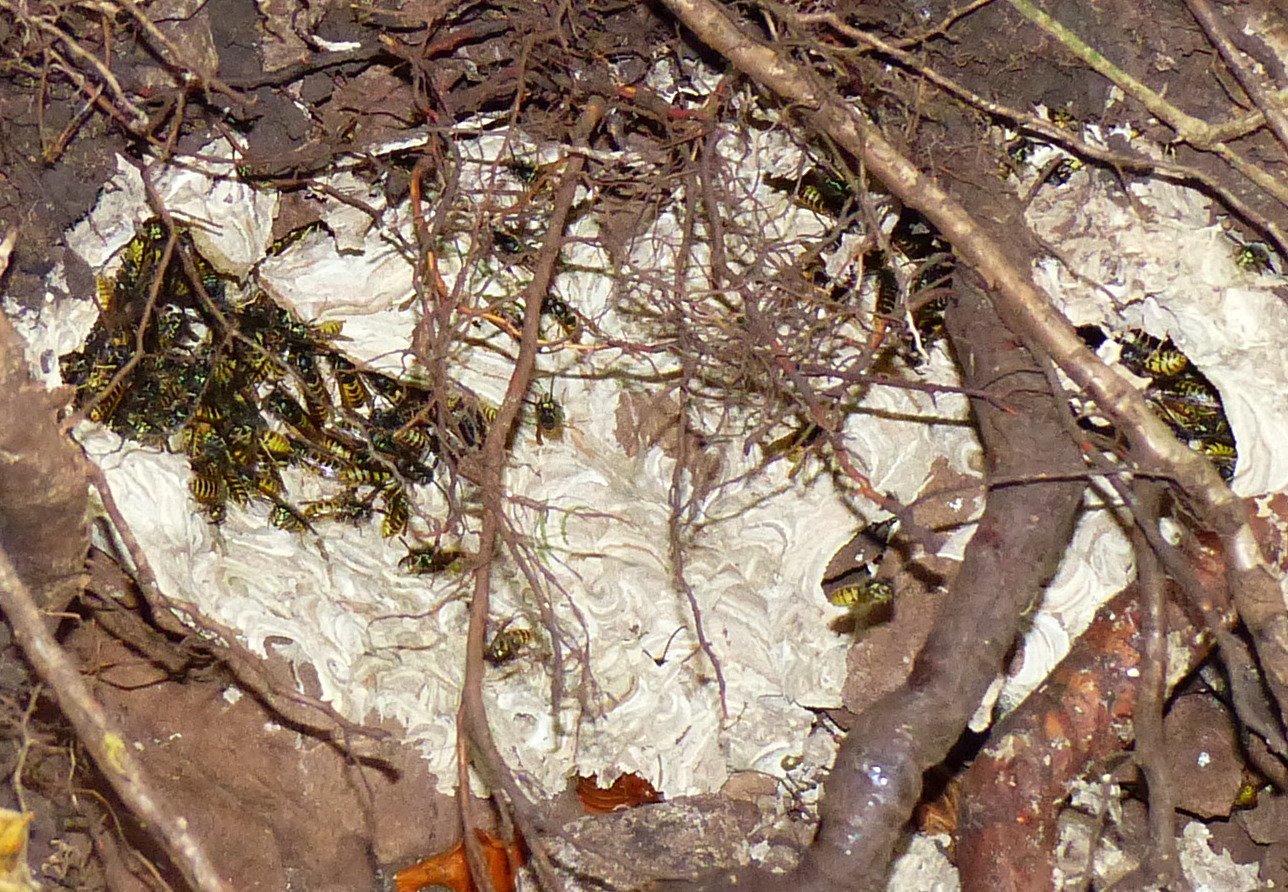
This warning has appeared over the last few days and can be seen on the Triangle. Wasps of course are a natural part of the wildlife of the wood but also can be major inconvenience. I took this photo of the nest early on Saturday morning and the wasps didn't cause me any problem at all. I could get very close and they didn't take any notice of me. They didn't see me as a threat. Unfortunately I didn't take a photo of the sign at the same time. I went back with my wife later in the afternoon to take this photo of the sign and the wasps had clearly been upset through the day and one got into my wife's hair and stung her on the head as we tried to remove it. She was several metres from the nest. Fortunately not a serious problem and antihistamine cream relieved the discomfort. I had one in my hair but it came out without stinging. I don't know what will be done to reduce the danger. It seems  a shame to destroy the nest but it is beside one of the major paths in the wood and children are certainly at risk. I expect it will be the Council's decision and they will have to consider the risks to people which include the possibility of anaphylactic shock. In the meantime make a detour when you see the sign.  I'll copy a paragraph about the life history of wasps from a website and paste it below....................

"At the end of the summer, the wasp colony takes on a different function. The queen now starts to lay 'different' eggs. These will eventually emerge as males (drones) and new young queens. The activity becomes 'very active' and the workers are super protective about their nest.
The young queens mate with several drones to become fertilized for the following year.
Eventually the whole colony dies off apart from the new queens who like the queens before them, find a suitable place to hibernate for the winter."

For more information about wasps from the website click here.


This is an entrance into Badock's Wood from Doncaster Road. Perhaps not as well known as the main Doncaster Road entrance but the trees here can be very colourful. The lane is about a hundred or so metres long before it opens out into the wood beside the Trym. One side of the lane has houses and the other side has a fenced off wooded area which is inaccessible from Badock's Wood.


Enjoy your walks in the wood but watch out for the wasps !!


If you have any comments please send them to me at: badockswood@virginmedia.com .

If you would like notification of future posts enter your email address in the box at the top right of page.

mike townsend